
Curriculum
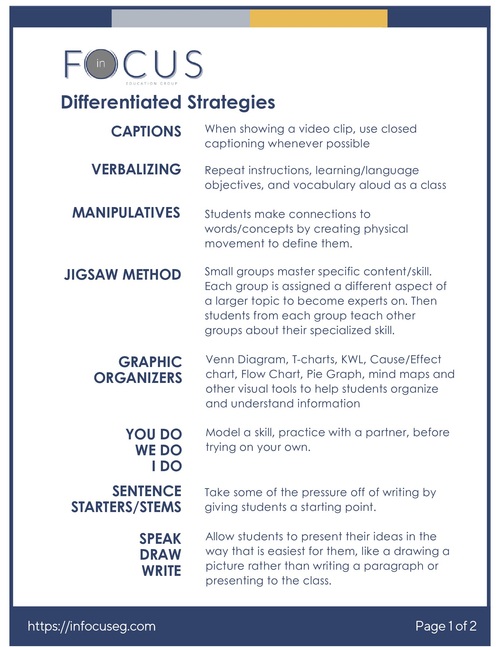
Students bring diverse learning needs, including differences in readiness, language proficiency, abilities, background knowledge, interests, and support needs. In Focus lessons are intentionally designed with a variety of instructional strategies and learning activities to support these differences, promote accessibility, and provide meaningful opportunities for all students to engage and succeed. For more information about the research behind differentiation, see the “Differentiation” article.
What is differentiation?
Differentiation is the intentional practice of adapting instruction to meet the diverse learning needs, abilities, and interests of students. It recognizes that students learn in different ways and may require varying levels of support to achieve the same learning goals.
Education researcher Carol Ann Tomlinson identified four key areas of differentiation:
- Content: What students learn and how they access information.
- Process: How students engage with and make sense of learning.
- Product: How students demonstrate their understanding and skills.
- Learning Environment: The physical, social, and emotional conditions that support learning.
Differentiation does not mean lowering expectations or creating entirely different lessons for every student. Rather, it involves using flexible instructional strategies, resources, and supports to ensure all students can access the content, engage meaningfully, and work toward shared learning objectives.
A research-aligned differentiated classroom does not require a separate lesson plan for every student. It is a planned, iterative cycle where the following steps should be followed:
- Identify a common learning target.
- Gather evidence of starting points.
- Anticipate barriers.
- Design common instruction with built-in access.
- Adjust, support, and challenge based on the needs of your students.
- Check impact.
This approach aligns with the evidence-based concept often called adaptive teaching. In this approach, educators use information about student learning to adjust the level and type of support while preserving high expectations (Education Endowment Foundation).
How does differentiation impact student well-being?
Differentiated instruction supports both academic success and student well-being by creating learning experiences that are accessible, engaging, and responsive to individual needs.
Research suggests that differentiated instruction can improve student learning by incorporating evidence-based practices such as scaffolding, vocabulary development, flexible grouping, and collaborative learning.
Beyond academic achievement, differentiation helps students experience success, build confidence, and develop a sense of belonging. When students feel supported, capable, and included in the learning process, they are more likely to engage, persevere through challenges, and develop a positive sense of themselves as learners.
Ultimately, differentiation supports student well-being by ensuring that every student has meaningful opportunities to learn, grow, and succeed.
How can this resource be used?
This resource is designed to help educators recognize the differentiation strategies embedded throughout In Focus lessons and apply these practices across their own classroom instruction.
The strategies highlighted in this document are practical, flexible, and adaptable to a variety of learning environments and student needs. Our goal is to equip educators with simple, actionable strategies that make differentiation more manageable, meaningful, and effective for all students.
References:
- Cleaver, S. (June 19, 2024). What Is Differentiated Instruction? We Are Teachers.
- Eaton, J. (October 19, 2022). Moving from ‘differentiation’ to ‘adaptive teaching’. Education Endowment Foundation.
- Hawker Brownlow Education. (July 30, 2013). Differentiation and The Brain: A discussion with Carol Ann Tomlinson. [Video]. Youtube.