
Discussion Protocols
Curriculum
Technology Support
Good discussions within a classroom help students foster a sense of community, make meaningful connections, and deepen their understanding of any given subject. For more information about the research behind using discussion protocols, see the “Why We Use Discussion Protocols” article.
Why Engage Students in Discussion?
Meaningful academic discussion is an important part of learning. It gives students repeated opportunities to explain their thinking, listen to others, use evidence, consider different perspectives, and refine their understanding.
Effective discussion supports learning in several important ways:
- Deepens understanding: Putting ideas into words helps students clarify their thinking, make connections, and build on prior knowledge.
- Strengthens learning and recall: Talking about concepts requires students to retrieve and rehearse what they have learned, helping strengthen retention.
- Develops reasoning: Students practice supporting their ideas with evidence, examples, data, or text rather than relying only on opinions.
- Expands thinking: Hearing different perspectives and approaches can reveal misconceptions, introduce new strategies, and encourage students to reconsider or extend their thinking.
- Builds academic language: Discussion provides authentic opportunities to practice vocabulary, sentence structures, and discipline-specific ways of communicating.
- Promotes metacognition: Explaining an idea helps students recognize what they understand, where they are uncertain, and what they may need to reconsider.
In Focus Discussion Protocols
Discussion is intentionally embedded throughout In Focus lessons and activities. Rather than simply receiving information, students are invited to make connections, share experiences, consider different perspectives, and apply concepts to their own lives.
Student discussion also makes learning more responsive. Teachers can listen to student thinking, identify needs or misconceptions, and adjust instruction based on student understanding, instructional goals, and available time.
To support this flexibility, Essential Questions (EQ) are identified in bold throughout the lessons. When time is limited, teachers can prioritize these questions to maintain the essential learning and purpose of the lesson.
What Are Discussion Protocols?
Discussion protocols are simple, structured strategies that help students participate meaningfully in classroom conversations. They provide clear expectations for how students will think, share, listen, respond, and collaborate.
The protocols included in this resource offer a variety of low-risk, high-engagement strategies that teachers can use to increase student participation while creating safe and productive opportunities for students to communicate their thinking.
Teachers can select and adapt protocols based on the age and needs of their students, the purpose of the discussion, available time, and desired level of interaction. Using a variety of protocols helps ensure that classroom discussion extends beyond the students who are most comfortable raising their hands and creates more opportunities for every student to think, engage, and contribute.
How Is the Discussion Protocols Resource Organized?
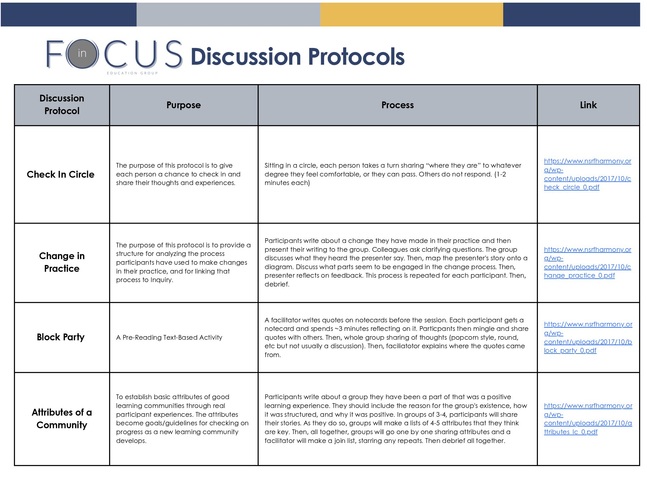
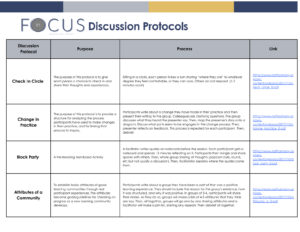
Various discussion protocols are listed in rows along with the specific purpose of the protocol, process for implementing the protocol, and a link to a page containing more information about the protocol.
How can this resource be used?
Think of this resource like a toolbox full of implements you can use to strengthen discussions in your classroom. You can pick and choose which tools to try based on the needs of your students.
References:
- National School Reform Faculty. (2026).