
Counselor/Supplemental Lessons
Curriculum
Technology Support
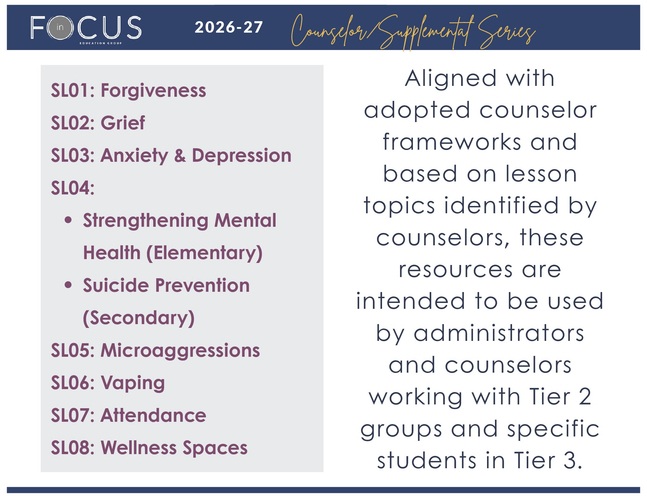
Our Counselor/Supplemental Lessons are designed for administrators, counselors, and other student support professionals to use with small groups or individual students who need additional targeted support.
Why include these topics in a well-being curriculum?
Many students, families, and communities are navigating complex challenges that can significantly impact well-being and learning. These lessons provide research-based resources that can be used within a Multi-Tiered System of Supports (MTSS) to provide targeted instruction and intervention for students who need additional support.
How are these lessons intended to be used?
These lessons are primarily designed for small-group or individual instruction (Tier 2 and Tier 3). However, depending on the needs of the school or community, many of the lessons can also be effectively implemented as Tier 1, whole-class instruction.
How were the lessons in this series selected?
The lessons in this series were requested by teachers, administrators, and counselors. They were written in consultation with school counselors and behavior specialists.
What if the examples do not apply to my students or school?
The lessons are intentionally written to be broadly applicable while providing meaningful, relevant examples. We encourage educators to adapt the examples, strategies, and discussion prompts to align with the unique needs of their students and their school’s policies and practices.
How do I access the Supplemental/Counselor lessons?
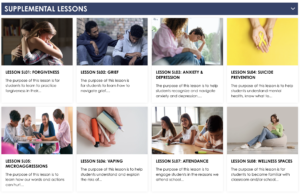
A license for the In Focus curriculum includes access to all Counselor/Supplemental lessons. By default, these lessons are only available for administrators and school counselors. However, access may be changed by an administrator. They are the last unit of our well-being series, with the heading “SUPPLEMENTAL LESSONS.”
What else should I consider?
Because these topics may address sensitive or personal experiences, we recommend communicating with parents or guardians before teaching the lessons. Whenever possible, these conversations are most effective when supported through a collaborative partnership between school and home.
References:
- Utah State Board of Education. (October 2024). Utah K-12 Comprehensive School Counseling Program A Technical Assistance Document. [PDF].